
Lafayette Public Records by Custodian
Lafayette has no single records warehouse. City Hall keeps council, planning, permit, staff, and administrative files. Contra Costa County offices in Martinez hold most name-bearing land, tax, court, custody, marriage, birth, and death material. State agencies add vital certificates, prison records, business filings, and professional licenses. California law favors access to a reasonably described, nonexempt government record, but access can mean free inspection, an online index, or a paid copy rather than unrestricted web display.
| Record group | Responsible office | Web route | Practical access |
|---|---|---|---|
| Deeds, liens, maps | Contra Costa Clerk-Recorder | RecorderWorks | Free index from 1986; copies ordered online or from office |
| Civil, small claims, probate, criminal | Contra Costa Superior Court | Public Portal and Open Access | Coverage varies; older files and many documents require Court Records |
| Assessment and parcel data | County Assessor | ParcelQuest Lite, CCMAP, Parcel Viewer | Address or APN online; owner names through counter or request |
| Birth, death, marriage | County Clerk-Recorder or CDPH | Request pages, not an open certificate index | Authorized or informational copy rules apply |
| Current custody and registries | Sheriff, CDCR, California DOJ | In-Custody Locator, CIRIS, Megan's Law | Only current and legally disclosable data appears |
| City minutes, planning, permits | Lafayette City Clerk and departments | City pages and ePermits | Online status or city records request |
Sealed cases, juvenile and adoption files, protected addresses, confidential marriages, and some military discharge records do not become open merely because an index exists. Vital certificates have separate eligibility rules. An index entry is also not the underlying image, which may cost a fee or remain restricted.
RecorderWorks Fields for Lafayette Records
The Clerk-Recorder property-document page sends Lafayette researchers to RecorderWorks. Its official index spans January 1, 1986 through the current endpoint. The APN route applies to deeds recorded from March 3, 1997 forward. APN means assessor parcel number, the county's parcel identifier. Name searches use a last name followed by a first name, and the help text recommends a partial first name when a broad query risks timing out.
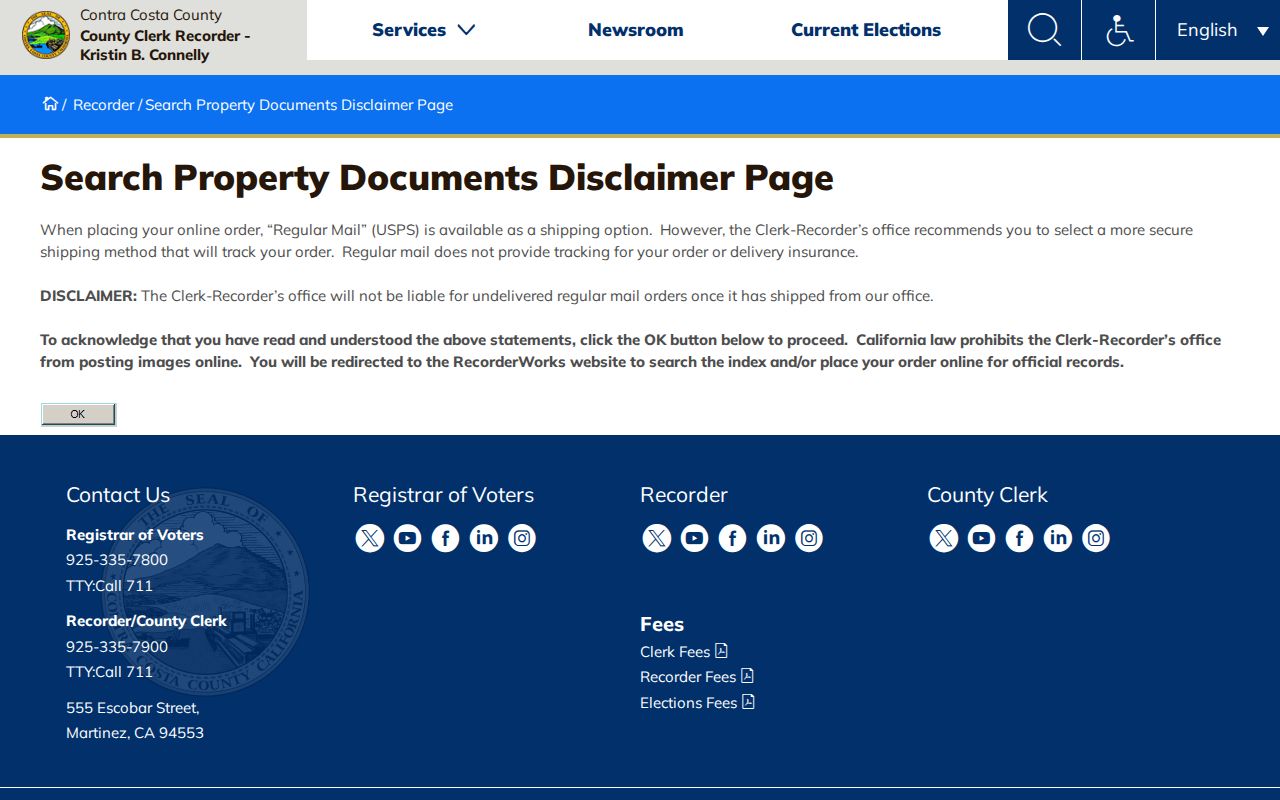
The county screen is the bridge to the index and online ordering. Inside RecorderWorks, choose the field that matches the known fact rather than the slower global search.
| Portal field | Input | Use and limit |
|---|---|---|
| Party role | All, grantor, or grantee | Grantor usually gives an interest; grantee receives one |
| Person or business name | Last name, then first name | Last name required; partial match is available |
| Date range | MM/DD/YYYY | Constrain a name or document-type query within online coverage |
| Document number | Instrument number | Best when a citation or prior record supplies the exact number |
| Book and page | Two numeric fields | Portal labels this route for 1986 through 1993 |
| APN | Parcel number | Deed search from March 3, 1997 forward |
| Legal description | Indexed legal terms | Useful when the formal property description is known |
Results can show a document number, instrument type, recording date, indexed parties, book and page, and APN. Opening the number reveals the entry; the cart starts a copy order. The free index is not a certified copy.
Lafayette Records Changed Numbering
Older Lafayette land records use a different filing language. Before 1980, the recorder assigned book and page references. Annual continuous instrument numbers began in 1980, yet tract maps, parcel maps, and similar map records still use book and page. RecorderWorks begins in 1986, leaving a gap between historic paper systems and the web index.
A pre-1986 deed may require physical indexes, a book-page citation, or archive help. Contra Costa County Historical Society holds county and court material from the 1850s into the mid-20th century. Its physical indexes are not all online. An old Lafayette transaction can therefore be absent from a modern query without having vanished.
Note: Maps can still use book and page even when related deeds carry modern instrument numbers.
Lafayette Court Records Beyond Portals
Contra Costa Superior Court, not a Lafayette municipal court, keeps local trial-court files. The online case system covers civil and small-claims documents and minutes where posted, with civil documents filed after November 13, 2007 generally within web coverage. Probate registers of actions are online, but probate documents and orders require Court Records. The non-criminal Court Records page sets out the request routes.
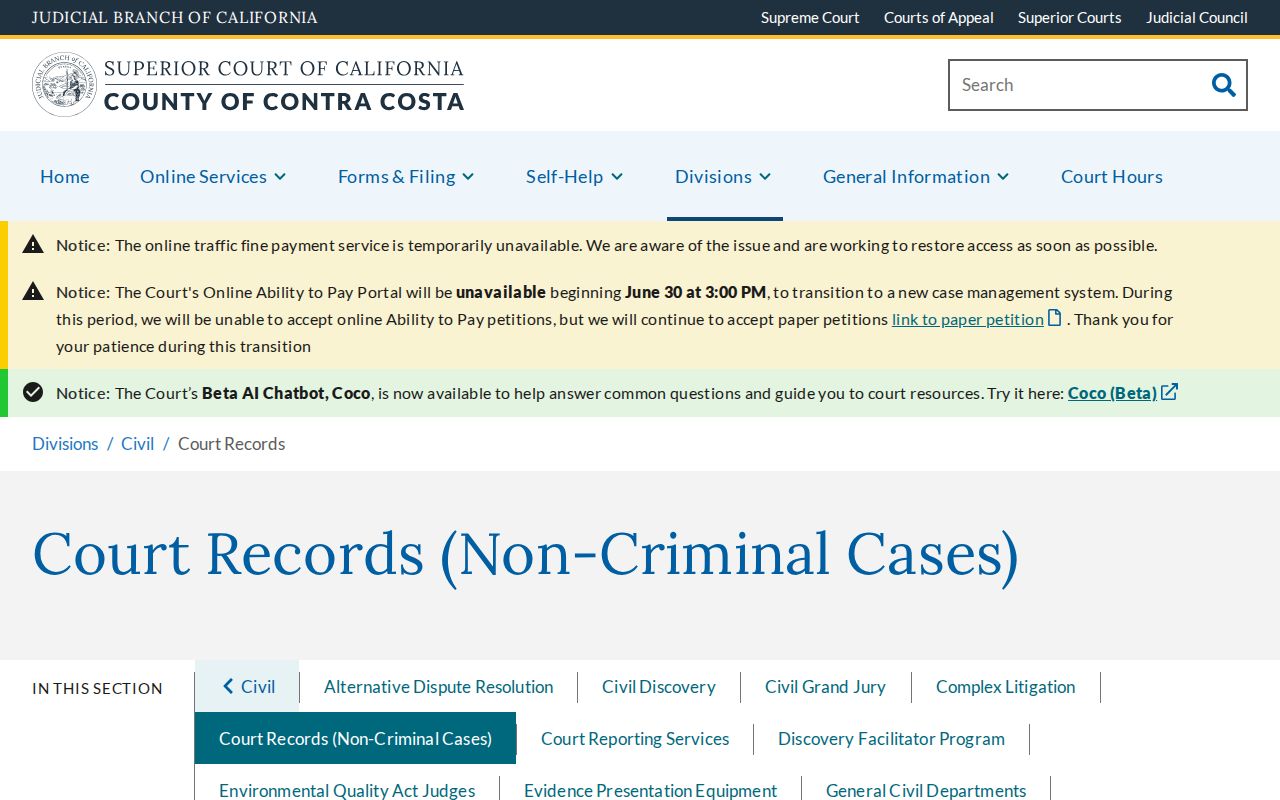
The non-criminal records page shows why the portal is only one channel. Files before the civil cutoff are stored off-site and may take about ten business days to reach the courthouse. A mail name search requires the court form and a self-addressed stamped envelope. In-person file viewing requires valid identification.
Is every Lafayette case online? No. Limited unlawful detainer information, probate documents, criminal minutes and orders, sealed matters, and older files need a phone, mail, counter, or records-unit route. Federal cases belong in PACER for the Northern District of California, not the county portal.
Court Scanning Changes Lafayette Access
The Superior Court is scanning 12 million pages from case files, microfiche, microfilm, and paper records. It seeks paperless files and more web access. Criminal and traffic records are excluded. Scanning can affect request timing.
Criminal indexes use the Public Portal or Open Access, but minutes, case documents, and orders are not posted online. The criminal court records page lists the branch and form routes, including CR-147 for a search and CR-114 for copies. The court warns that most in-person criminal file-copy requests cannot be handled at once.
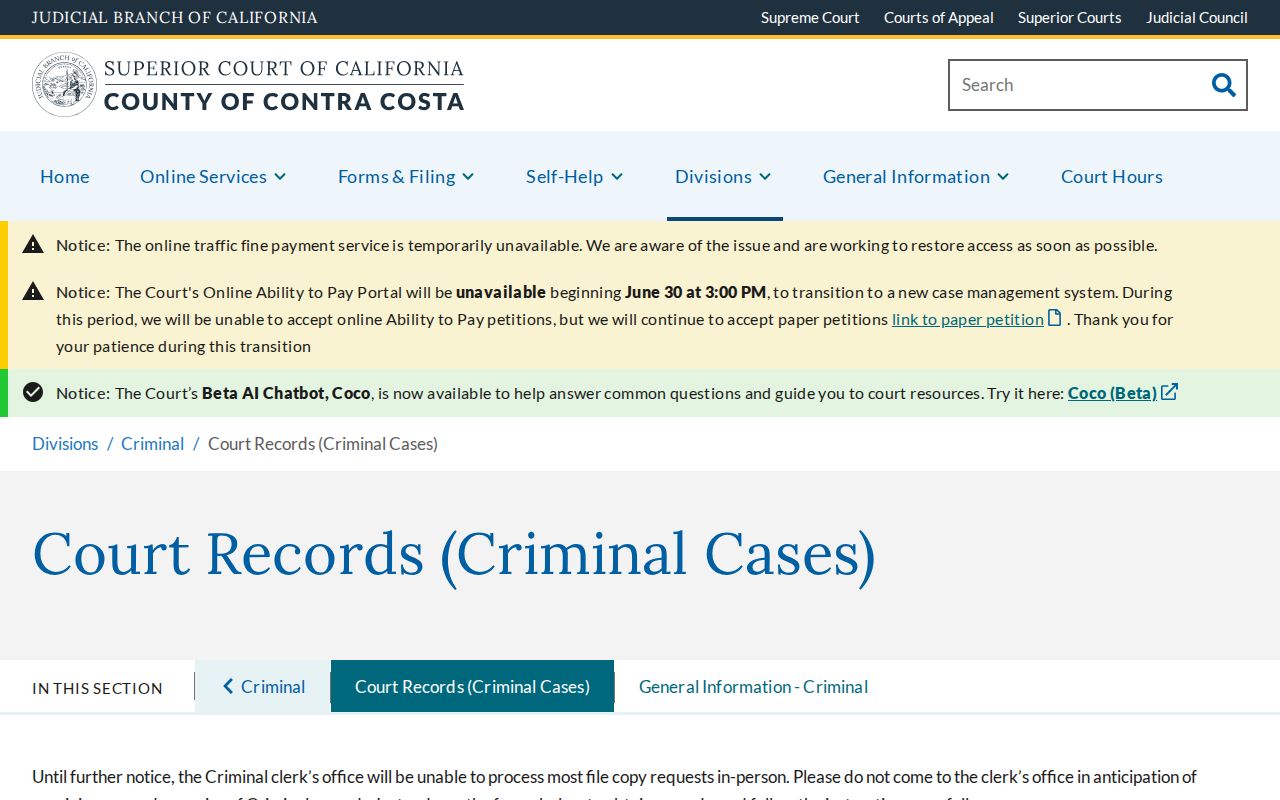
The screen directs a requester to the correct channel. Martinez, Pittsburg, and Richmond branches share the main phone, but file location controls the copy route.
Lafayette Property Records Hide Names
Contra Costa ownership data is public on the assessment roll, yet the Assessor does not publish any owner names on its website. The county cites the need to protect home addresses of officials, safety officers, and retired officials. This is a web-display limit, not a claim that ownership itself is secret.
Start online with an address or APN in ParcelQuest Lite, CCMAP, or the Parcel Viewer. ParcelQuest shows parcel maps, assessed values, and house details, with free detail capped at 50 searches and 25 maps per month. For ownership or assessment-roll details omitted online, contact the Assessor counter. A Lafayette Community View map may add zoning, flood zones, property lines, aerials, and street status, but the city warns that tool has not been supported since 2018.
Insider tip. Public ownership does not mean online owner-name search. Carry the APN from the map portal to the Assessor counter or an official request.
Note: A parcel is the legally mapped piece of land; its situs address is the physical site, while a tax mailing address may differ.
Lafayette Vital Records Copy Rules
Lafayette birth, death, and marriage events are county or state records. The city refers requesters to the Contra Costa Clerk-Recorder, while the California Department of Public Health supplies statewide certificates. CDPH has maintained California birth records since July 1905. It offers authorized certified copies to eligible applicants and informational certified copies to others, rather than opening every modern certificate as a name index.
Health and Safety Code section 103526 governs the authorized and informational split. An authorized birth, death, or marriage request uses the proper form and a notarized sworn statement. Informational copies carry a legend stating that they are not valid for identity purposes. Confidential marriage copies are limited to a registrant or a person with a court order under Family Code sections 509 and 511. Sealed records use a separate process.
Fees effective January 1, 2026 are $31 for birth, $26 for death, $19 for marriage, $18 for dissolution, and $23 for fetal death. A divorce certificate from CDPH is distinct from the Superior Court judgment and file. For a local event, the county office may be the faster route.
Lafayette Custody Records Have Limits
The Contra Costa Sheriff In-Custody Locator searches a first and last name together or an exact booking number. It covers current county custody, not a full arrest history. If a person does not appear, the Sheriff advises checking with the local jurisdiction. The Martinez Detention Facility is the county's primary intake point.
CDCR's CIRIS locator can show a current prisoner's name, number, age, location, commitment counties, admission date, and parole data. The California DOJ Megan's Law Registry displays only what state law permits. An omission proves nothing either way. Court, jail, prison, and registry records remain separate.
Lafayette Records Offices and Counters
The key public records counters are in Martinez because Lafayette is not the county seat. Each office controls a different file system, fee schedule, and fallback. Calling the right custodian before traveling can prevent a wasted counter visit, especially for off-site court files or property details withheld from the web.
Contra Costa Assessor
2530 Arnold Drive, Suite 100
Martinez, CA 94553
(925) 313-7400
Superior Court Records
725 Court Street, Room 103
Martinez, CA 94553
(925) 608-1000
Lafayette City Clerk
3675 Mt. Diablo Boulevard, Suite 210
Lafayette, CA 94549
(925) 284-1968
The Assessor's office and phone hours are weekdays from 8 a.m. to 4 p.m. Court Records keeps the same counter hours, but its phones close at 3 p.m. Lafayette refers deeds, fictitious business names, and vital records to the county.
Fees Across Lafayette Record Systems
Inspection and portal use can be free even when copies cost money. Lafayette charges 10 cents per standard page for city copies, with added cost for oversize material. Court Records charges 50 cents per page. A court certification costs $40 plus page charges, while a certified divorce judgment costs $15 including copies.
Assessor counter prices are different: a map page costs $3, mailing adds $2.50, a property-information printout costs $1 per page, and property characteristics cost $7.50 per parcel. A radius search costs $50. RecorderWorks searching is free, but the exact image price appears in the order flow. CPRA charges generally cover direct duplication or a statutory fee, while a custom electronic extraction can carry programming or production cost.
CPRA Terms for Lafayette Records
The California Public Records Act uses terms that matter when a request crosses city, county, and court systems. A clear request identifies a record closely enough for staff to locate it. It does not need legal jargon, and Lafayette may not demand a reason for an ordinary CPRA request.
- Custodian
- The agency or office that keeps and controls the requested record.
- Index
- A searchable list of entries. It is not always the document image or full case file.
- Certified copy
- An official copy bearing the custodian's certification, usually for an added fee.
- Exemption
- A legal reason that permits or requires an agency to withhold all or part of a record.
Government Code section 7922.535 requires a determination within 10 days after receipt of a copy request. Written notice can add up to 14 days for unusual circumstances, such as a search across field offices, a large volume, consultation with another agency, or work needed to compile electronic data. A determination is not always the delivery date. If records are disclosable, the agency must estimate when they will be available.
Request Lafayette Public Records
Use a formal request when an index stops at a date boundary, a city file is not posted, or an office controls details that cannot be displayed online. Under the CPRA, any person may ask for a reasonably identifiable, nonexempt state or local agency record. Court case files follow court procedures and fees rather than the city's request route.
- Name the custodian. Send city minutes to Lafayette, deeds to the Clerk-Recorder, assessment-roll details to the Assessor, and case documents to Court Records.
- Check the published channel. Use the portal or online index first. Save any case number, APN, document number, date, or department that will narrow the request.
- Describe the record. Give a useful date range, record type, names, address, and known identifiers. Ask for electronic delivery when that format already exists.
- Track the determination. Keep the submission and the agency's written response. The CPRA determination period is 10 days, subject to a written unusual-circumstances extension.
- Review cost and exemptions. Ask the office to explain copy charges, redactions, and each cited exemption. Narrow an overbroad request when that will reach the needed file faster.
Lawful personal use. Use Lafayette records for legitimate family, estate, property, consumer-safety, or civic research. Never use a name, address, or filing to stalk, harass, threaten, or expose a protected person.
A denial is not always final. The CPRA permits court enforcement, and Government Code section 7923.115 addresses fees for a prevailing requester. First ask which search and exemption the custodian used, and whether a redacted portion can be released.